You’re bleeding talent and you don’t even realize it.
Every day, qualified candidates search for opportunities at your company. They type “[Your Company] careers” into Google. But instead of landing on your professional career pages, they hit dead ends. Error messages. Confusing redirects. Or worse they find your competitors instead.
This isn’t just a technical headache. It’s a recruitment crisis hiding in plain sight.
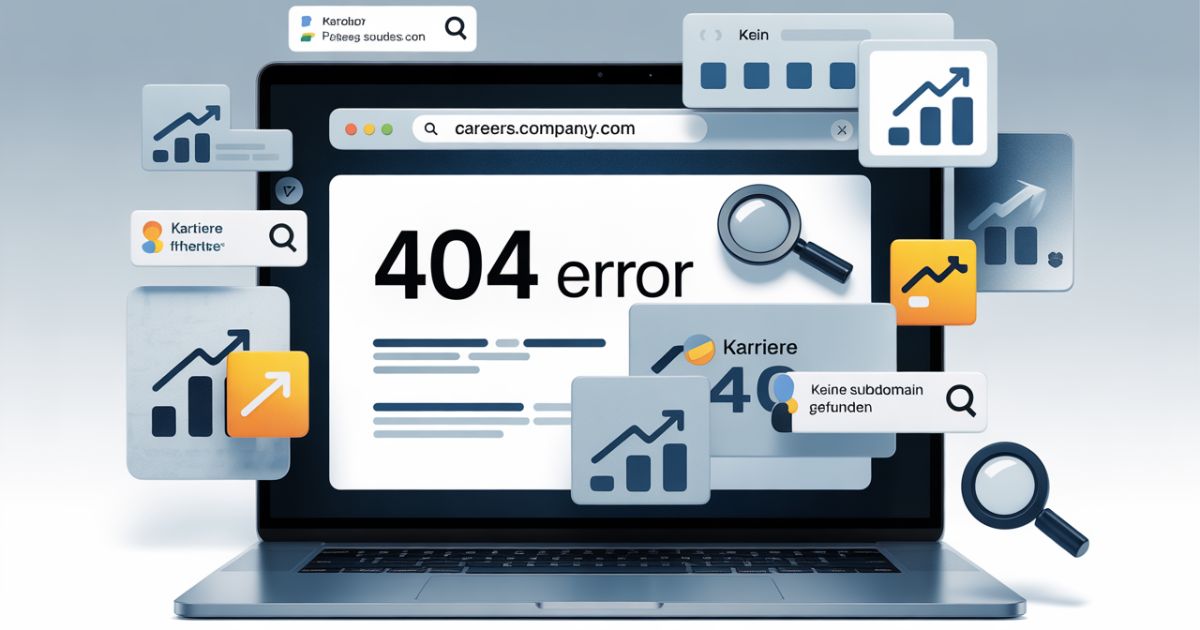
The “keine karriere-subdomain gefunden” error sounds obscure, especially if you don’t speak German. But this technical SEO warning affects companies worldwide, including right here in the US. It signals that search engines can’t properly locate your karriere-subdomain or career section which means neither can your future employees.
Let’s fix this today. No jargon. No confusion. Just actionable solutions that work.
Understanding What “Keine Karriere-Subdomain Gefunden” Means
Translating the Technical Gibberish
“Keine karriere-subdomain gefunden” translates directly to “no career subdomain found.” When SEO crawlers or website diagnostics run, they’re hunting for your dedicated karriereseite (career page). They expect clean structure. What they find instead? Nothing. Chaos. Broken paths leading nowhere productive.
This error appears in:
- SEO audit reports from tools like Screaming Frog
- Google Search Console warnings you’ve been ignoring
- Job aggregator platforms rejecting your feed submissions
- Third-party recruitment platform diagnostics showing red flags
Think of it like this: You built a beautiful office. You hired incredible people. But you forgot to put your address on Google Maps. Candidates drive around lost while competitors welcome them inside.
The Subdomain vs. Subdirectory Debate
Here’s where people get confused fast. Let’s simplify.
A subdomain looks like: careers.company.com
A subdirectory looks like: company.com/careers
Both work technically. But they signal different things to search engines and candidates.
| Aspect | Subdomain (careers.company.com) | Subdirectory (company.com/careers) |
|---|---|---|
| Domain Authority | Treated as separate site initially | Inherits full domain authority immediately |
| Branding | Stronger career brand separation | Unified company brand experience |
| Technical Setup | Requires DNS configuration | Simpler folder creation |
| SEO Value | Builds independent authority | Consolidates all SEO signals |
| Best For | Large enterprises, multiple regions | Most small-medium businesses |
The “karriere-url keine karriere-subdomain gefunden” warning often means you’ve set up neither properly. You’re using external platforms exclusively. Or your internal linking is so broken that crawlers can’t discover your jobseite at all.
Why Career Subdomains Matter for SEO and Trust
Google Jobs Won’t Find You Otherwise
Google Jobs changed everything. When someone searches “marketing manager Chicago,” Google displays job listings directly in search results. No clicking required. Massive visibility. Completely free.
But there’s a catch. Google needs clean URL-struktur to index your positions. It needs JobPosting schema markup. It needs crawlable content. Without proper karriere-seitenstruktur, you’re invisible in this lucrative channel.
Companies with optimized career pages see 40-60% more organic job applications. That’s not speculation that’s measured reality from recruitment analytics.
Candidates Judge Your Company in Three Seconds
When job seekers land on your karrierebereich, they’re evaluating more than open positions. They’re assessing:
- Professional appearance signaling company competence
- SSL/HTTPS security showing you protect data
- Mobile optimierung proving you’re modern
- Ladegeschwindigkeit respecting their time
A broken karriere-subdomain screams dysfunction. It whispers: “If they can’t get their website right, what’s their culture actually like?”
Your arbeitgebermarke (employer brand) suffers before anyone reads a single job description.
Common Reasons for the “Keine Karriere-Subdomain Gefunden” Issue
Third-Party Platforms Replaced Your Native Pages
Here’s the most common culprit: You outsourced everything to external applicant tracking systems. Workday. Greenhouse. Lever. These platforms handle applications beautifully but they destroy your SEO.
When candidates click your “Careers” button, they leave your domain entirely. They land on externalats.com/yourcompany. Google sees this. It knows you’re not hosting stellenangebote (job listings) on your own site.
Result? Zero domain authority building. No crawl budget invested in your brand. Competitors who host content natively outrank you for branded searches.
DNS Configuration Disasters
Sometimes the problem is purely technical. Your IT team created careers.company.com but never configured DNS records properly. The subdomain für jobs exists in theory but fails in practice.
Common DNS mistakes include:
- Missing or incorrect CNAME records pointing nowhere
- A-records configured for wrong IP addresses
- SSL certificates not covering the subdomain
- Cloudflare settings blocking search engine access
Run this quick test: Type your career subdomain directly into a browser. Does it load? Does the SSL certificate show your company name? If not, you’ve found your problem already.
JavaScript-Heavy Pages Hiding Everything
Modern web design loves JavaScript frameworks. React. Angular. Vue. They create beautiful, interactive experiences and complete SEO disasters if implemented incorrectly.
JavaScript-heavy pages often fail to render content for crawlers. The jobseite loads perfectly for humans but appears blank to Google indexing bots. Your carefully crafted job listings might as well not exist digitally.
This creates indexierung (indexation) problems. Google can’t read your content. It can’t understand your structure. The “karriere seite keine karriere-subdomain gefunden” error follows predictably.
SEO Implications of Missing Career Subdomains
Your Rankings Evaporate for Critical Keywords
Without proper karriere-URL structure, you’re surrendering valuable search territory. Consider these long-tail keywords you’re probably losing:
- “Marketing manager jobs at [Company Name]”
- “Software engineer careers [City]”
- “[Company Name] benefits and culture”
- “How to apply to [Company Name]”
These searches represent people already interested in your organization. They’re warm leads. But when your karriereseite doesn’t rank, competitors and job boards intercept them instead.
The crawl-budget waste compounds over time. Search engines allocate limited resources to each site. When they repeatedly find crawling-probleme (crawl issues) in your career section, they stop visiting frequently. Your fresh job postings take weeks to appear in results if they appear at all.
Duplicate Content Penalties Lurk
Many companies post identical job descriptions across multiple platforms. Your website (if you have one). LinkedIn. Indeed. Glassdoor. ZipRecruiter.
Without strong interne verlinkung (internal linking) and clear canonical tags, search engines can’t determine which version is authoritative. They might index Indeed’s copy instead of yours. Now Indeed ranks for your own company’s job openings.
That’s devastating for talent acquisition online.
Read This Article: The Truth Behind the “Caliente Cartel”: What People Really Mean When They Search This Mysterious Term
Technical SEO Considerations for Career Subdomains
Schema Markup: Your Secret Weapon
Structured data transforms how search engines understand your content. JobPosting schema specifically tells Google:
- Job title and description
- Salary range (when provided)
- Employment type (full-time, contract, etc.)
- Location and remote options
- Application deadline and posting date
Implementing schema markup correctly unlocks rich results in search. Your listings display with enhanced formatting. Candidates see critical details before clicking. Application rates skyrocket as targeting improves naturally.
Google’s Structured Data Testing Tool validates your implementation. Use it religiously. Every job posting deserves proper tagging consistently.
Robots.txt Directives Can Sabotage Everything
Here’s something website owners overlook constantly: Your robots.txt file might be blocking career pages entirely.
Navigate to: yoursite.com/robots.txt
Look for lines like:
Disallow: /careers/
Disallow: /jobs/
These robots directives tell search engines “don’t crawl here.” Seems obvious in retrospect but countless companies accidentally implement these blocks during website migrations or security implementations.
The fix? Remove unnecessary restrictions. Allow crawlers access to your indexable URL structure. Monitor changes through search console data afterward.
Internal Linking: The Overlooked Foundation
Crawl efficiency depends heavily on how well your site connects internally. Career pages often exist as orphaned islands. No navigation links. No footer references. No contextual connections from main pages.
Search engines discover content by following links. If your karriereunterseite (career subsection) connects to nothing, it might as well not exist for SEO purposes.
Strategic internal linking for careers includes:
- Header/footer navigation prominently featuring career links
- Homepage blocks highlighting current openings
- About Us pages linking to culture content
- Blog posts referencing career opportunities contextually
- Job descriptions linking between related positions
This creates semantic connections. It builds keyword relevance throughout your domain. It improves domain authority distribution across all pages.
How to Fix “Karriere-URL Keine Karriere-Subdomain Gefunden”
Step One: Audit Your Current Setup Ruthlessly
Before changing anything, understand what exists today. Run comprehensive diagnostics using:
Free tools include:
- Google Search Console for indexation status
- Screaming Frog (free version) for crawling
- Google’s Rich Results Test for schema validation
- SSL checker for security configuration
Paid tools provide deeper insights:
- Ahrefs for backlink analysis and rankings
- SEMrush for competitive career page research
- Moz Pro for domain authority tracking
Document everything. Take screenshots. Note which pages exist. Which actually index. What errors appear repeatedly.
Step Two: Choose Your Structure Strategically
Should you build careers.company.com or company.com/careers? This decision impacts everything forward.
Choose subdomain (careers.company.com) when:
- You’re a large enterprise with multiple brands
- You need separate branding for recruitment marketing
- You’re managing international career sites (careers-uk.company.com)
- You have dedicated developers managing career infrastructure
Choose subdirectory (company.com/careers) when:
- You’re building from scratch today
- You want maximum SEO benefit immediately
- Your technical team is small or outsourced
- You need simple maintenance going forward
For most US companies under 500 employees, subdirectories win. They’re simpler technically. They inherit existing domain authority instantly. They consolidate SEO signals beautifully.
Step Three: Implement with Precision
Once you’ve chosen structure, execution matters tremendously.
For subdirectory implementation:
- Create clear URL hierarchy: company.com/careers/department/job-title
- Build navigation allowing easy browsing
- Add comprehensive filtering (location, type, department)
- Implement JobPosting schema on every listing
- Create XML sitemap specifically for career content
- Submit sitemap through Google Search Console
- Establish internal links from homepage prominently
For subdomain implementation:
- Configure DNS records (CNAME pointing to your server)
- Provision SSL certificate covering the subdomain
- Set up hosting (can share server with main domain)
- Build consistent design matching main brand
- Implement all SEO elements (schema, sitemap, etc.)
- Cross-link strategically between main domain and career subdomain
- Monitor both properties separately in Search Console
Timeline expectations:
- Technical setup: 1-2 weeks
- Content migration: 1-2 weeks
- SEO implementation: 1 week
- Testing and refinement: 1 week
- Full indexing and results: 2-3 months
Step Four: Validate Everything Obsessively
After implementation, verify meticulously:
- ✓ Career pages load quickly (under 3 seconds)
- ✓ Mobile experience works flawlessly
- ✓ Schema validates without errors
- ✓ Pages begin indexing within days
- ✓ No crawl errors appear in Search Console
- ✓ Internal links connect properly throughout site
- ✓ Application forms function across all browsers
- ✓ Analytics tracking captures candidate behavior
Use real devices for testing. Desktop. Mobile. Tablet. Multiple browsers. Nothing substitutes for human verification across actual usage conditions.
Aligning Career Pages with Google’s Helpful Content Update
Write for Humans, Not Algorithms
Google’s helpful content guidelines fundamentally changed SEO. They prioritize content quality over manipulation. Your karriereseite must serve candidates genuinely not just rank well artificially.
Menschen-zentrierter inhalt (people-first content) for careers means:
- Transparent hiring process details so candidates know what to expect
- Realistic role descriptions avoiding buzzword soup
- Salary ranges when legally and strategically possible
- Unternehmenskultur (company culture) showcased through employee stories
- Growth opportunities explained concretely, not vaguely
Skip the corporate-speak. Write conversationally. Answer questions candidates actually have. Demonstrate erfahrung und expertise (experience and expertise) by showing not telling what working there involves.
Showcase E-E-A-T Through Authenticity
Experience, Expertise, Authoritativeness, and Trustworthiness apply to recruitment content too. Google evaluates whether your career pages demonstrate these qualities genuinely.
Strong E-E-A-T signals include:
- Employee testimonials with real names and photos
- Team descriptions showing actual people, not stock images
- Candidate journey maps explaining the hiring process transparently
- Unternehmenswerte (company values) backed by specific examples
- Awards and recognition from legitimate industry organizations
Avoid manufactured authenticity. Candidates detect inauthenticity instantly. Your bewerbererfahrung (applicant experience) either reflects reality or becomes another broken promise that damages trust.
Measuring Success After Fixing the Issue
Track What Actually Matters
Vanity metrics feel good but mean nothing. Focus on user engagement metrics that impact business outcomes directly.
SEO performance indicators:
- Organic traffic to career pages (monthly growth)
- Rankings for target keywords (track top 20)
- Google Jobs impressions and clicks (via Search Console)
- Crawl efficiency improvements (pages crawled per day)
Recruitment success indicators:
- Application conversion rate (visitors → applications)
- Application quality scores (from hiring managers)
- Time-to-fill for positions advertised organically
- Cost-per-hire reduction from organic channels
Technical health indicators:
- Page load speed (aim under 2.5 seconds)
- Mobile usability scores (100/100 target)
- Core Web Vitals passing rates
- Crawl error resolution rate
Set up dashboards combining these metrics. Review monthly. Adjust strategy based on data not assumptions or opinions.
Celebrate Wins and Learn from Gaps
Implementation alone doesn’t guarantee success. Continuous improvement separates good career pages from exceptional ones driving organisches wachstum (organic growth).
When something works double down. When metrics disappoint investigate ruthlessly. A/B test different approaches. Try varied content formats. Experiment with employee video testimonials. Test different application form lengths.
The companies winning talent acquisition online treat their karrierebereich as evolving products, not static brochures. They optimize constantly. They respond to candidate feedback actively. They invest in skalierbare seitenstruktur (scalable page structure) supporting growth.
Frequently Asked Questions
How quickly will I see SEO improvements after fixing keine karriere-subdomain gefunden?
Technical fixes show results within 2-4 weeks. Full ranking recovery takes 2-3 months typically. Google needs time for re-crawling and re-evaluating your site thoroughly.
Can I keep using external ATS platforms?
Absolutely. Use API-based solutions to display job listings on your domain while maintaining ATS functionality. This gives you SEO benefits without sacrificing recruitment tools you love.
What if my CMS doesn’t support subdomains easily?
Most modern platforms support subdirectories perfectly. Go with company.com/careers instead. You’ll gain SEO advantages and avoid technical headaches completely.
How many job listings do I need for SEO success?
Quality beats quantity always. Three well-optimized authentic jobbeschreibungen (authentic job descriptions) outperform thirty thin, generic postings consistently.
Should German companies use “karriere” while US companies use “careers”?
Match your primary audience’s language. US companies should use “/careers” or “careers.company.com” exclusively. German-speaking markets prefer “/karriere” naturally.
Conclusion: Your Career Pages Deserve Better
The “keine karriere-subdomain gefunden” error isn’t just technical noise. It’s a symptom of deeper problems broken structure, lost opportunities, and invisible stellenangebote that never reach your ideal candidates.
Fixing this transforms recruitment fundamentally. You’ll build backlink-potenzial (backlink potential) as industry sites reference your career content. You’ll establish digitale sichtbarkeit (digital visibility) attracting passive candidates exploring options. You’ll reduce dependence on expensive job boards draining budgets.
Most importantly? You’ll gain control over your talent acquisition destiny.
Start today. Audit your current setup. Choose your structure. Implement methodically. Measure relentlessly.
Your future employees are searching right now. Make sure they find you not your competitors.
The talent war isn’t won with better benefits. It’s won with better infrastructure supporting every interaction from first search to final offer. Build that foundation correctly, and everything else becomes easier afterward.
Need help implementing these fixes? Search for “SEO audit for career pages” or “karriere-subdomain optimization services” to find specialists experienced with these specific technical challenges.