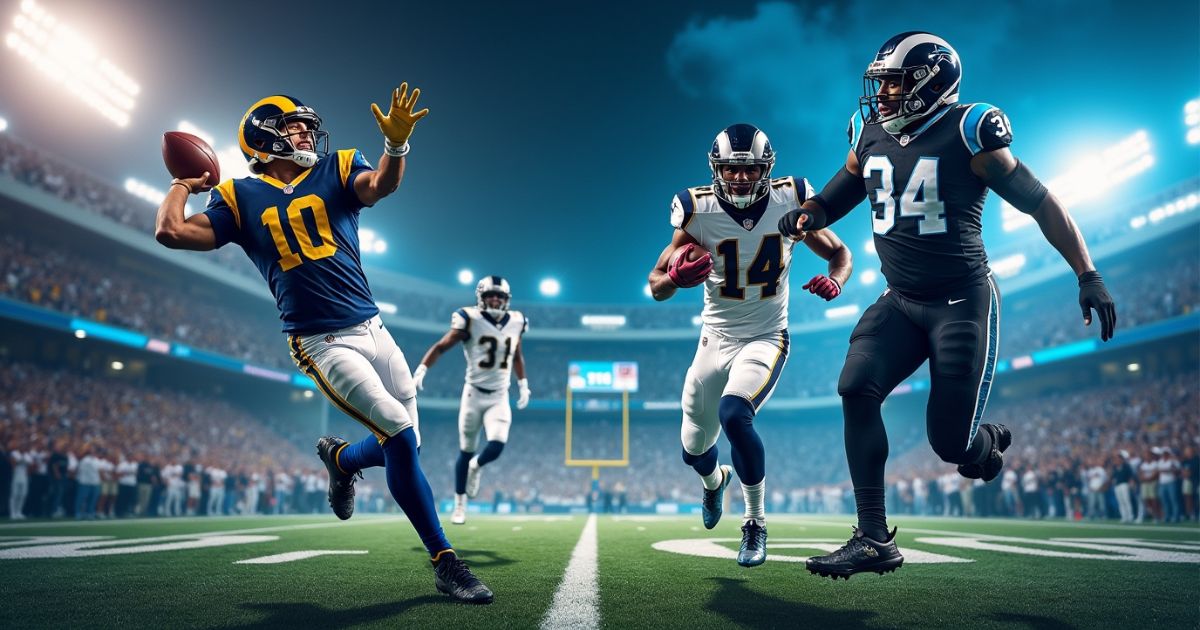
The 2026 NFL Wild Card Round delivered an instant classic as the Los Angeles Rams escaped Bank of America Stadium in Charlotte, North Carolina with a dramatic 34-31 victory over the Carolina Panthers on Saturday, January 10. This NFC Wild Card game showcased playoff resilience, clutch performances, and a final drive that will be remembered for years to come.
Quick Match Stats Table
| Category | Los Angeles Rams | Carolina Panthers |
|---|---|---|
| Total Yards | 411 | 333 |
| First Downs | 23 | 19 |
| Third Down Conversions | 8/15 (53%) | 5/13 (38%) |
| Time of Possession | 31:46 | 28:14 |
| Turnovers | 1 | 2 |
| Penalties/Yards | 6/48 | 4/35 |
| Sacks Allowed | 2 | 3 |
The Rams controlled possession and converted critical third downs at a higher rate, proving decisive in this postseason thriller. Their balanced offense generated 78 more total yards while limiting turnovers when it mattered most.
Quick Score Table
| Team | Q1 | Q2 | Q3 | Q4 | Final |
|---|---|---|---|---|---|
| Rams | 7 | 10 | 7 | 10 | 34 |
| Panthers | 7 | 14 | 3 | 7 | 31 |
Carolina showed offensive firepower early, taking a 21-17 halftime lead before the Rams’ fourth quarter surge sealed the Wild Card Weekend victory.
Final Score and Game Overview
The Los Angeles Rams defeated the Carolina Panthers 34-31 in a high-intensity matchup that showcased why the NFL playoffs remain utterly unpredictable. Playing in front of passionate fans at Bank of America Stadium, the 8-9 Panthers nearly pulled off a stunning upset against the 12-5 Rams.
Matthew Stafford orchestrated a game-winning touchdown drive with just 38 seconds remaining, connecting with Puka Nacua for a 19-yard touchdown pass that sent the Rams to the Divisional Round. The Panthers, led by dual-threat quarterback Bryce Young, fought valiantly but couldn’t overcome late-game execution issues and crucial turnovers.
This NFC playoff matchup featured multiple momentum swings, outstanding individual performances, and the kind of playoff intensity that separates championship-caliber teams from pretenders. The Rams’ victory showcased their offensive strategy and ability to perform under pressure.
Key Player Performances for the Los Angeles Rams
Matthew Stafford: Clutch Veteran Leadership
Matthew Stafford completed 24 of 42 passes for 304 passing yards, three touchdowns, and one interception. His playoff grit shone brightest on the final drive, where he converted two third downs and delivered the game-winning strike. Stafford’s passing attack balanced deep shots with quick releases, keeping Carolina’s defenders off-balance throughout.
Puka Nacua: Playoff Heroics
The star receiver hauled in 10 receptions for 111 receiving yards and the game-winning touchdown. Nacua’s ability to win contested catches in critical moments epitomized the Rams’ offensive performance. His chemistry with Stafford proved unstoppable in situational execution scenarios.
Kyren Williams: Dual-Threat Dynamic
Williams rushed for 83 yards while adding 5 receptions for 33 yards. His balanced offense contributions kept Carolina’s defense honest, opening up the passing lanes that Stafford exploited. Williams’ versatility as both a runner and receiver made him invaluable in third-down conversions.
Harrison Mevis: Steady Kicking
Mevis converted all four field goal attempts, including crucial kicks in the third quarter that maintained the Rams’ momentum when touchdowns weren’t available.
Key Player Performances for the Carolina Panthers
Bryce Young: Promising Postseason Debut
Despite the loss, Bryce Young showcased impressive maturity, completing passes for 295 passing yards and three touchdowns. The young quarterback demonstrated pocket awareness and delivered several clutch plays that kept the Panthers competitive. His dual threat capabilities added another dimension to Carolina’s offensive strategy.
Chuba Hubbard: Ground Game Warrior
Hubbard rushed for 116 rushing yards and two rushing touchdowns, consistently finding holes in the Rams’ defensive front. His physical running style wore down defenders and controlled tempo during critical possessions.
Jalen Coker: Emerging Star
Coker exploded for 134 receiving yards on 7 catches, becoming Young’s primary target. His ability to create separation and gain yards after catch provided the Panthers with explosive plays when they needed them most.
Read This Article: Gujarat Titans vs Mumbai Indians Timeline: Complete Match Story & Scorecard Analysis
Quarter-by-Quarter Game Summary
First Quarter: Feeling Out Process
Both teams traded touchdowns early. The Rams struck first with Colby Parkinson’s touchdown reception, but Carolina answered immediately with Hubbard’s first rushing touchdown. The defensive pressure from both sides created an intense playoff atmosphere.
Second Quarter: Panthers Seize Control
Carolina dominated the second quarter, scoring 14 unanswered points. Young connected with Coker twice for big plays, while Hubbard added his second rushing touchdown. The Rams managed only a Harrison Mevis field goal, entering halftime trailing 21-17. The NFC South team appeared poised for an upset.
Third Quarter: Rams Respond
Los Angeles adjusted their offensive strategy, leaning heavily on quick passes and Williams’ versatility. A touchdown and field goal gave them a 27-24 lead. Carolina’s offense sputtered with just one field goal, marking a crucial momentum swing.
Fourth Quarter: Thriller to the Final Whistle
Both teams exchanged scores in a back-and-forth quarter. Carolina tied the game 31-31 with 4 minutes remaining, setting up Stafford’s heroic final drive. The Rams marched 75 yards in just over 3 minutes, culminating in Nacua’s game-winning touchdown with 38 seconds left.
Passing Stats Breakdown: Quarterbacks in Focus
| Stat | Matthew Stafford (LAR) | Bryce Young (CAR) |
|---|---|---|
| Completions/Attempts | 24/42 | 22/35 |
| Passing Yards | 304 | 295 |
| Touchdowns | 3 | 3 |
| Interceptions | 1 | 1 |
| QB Rating | 87.4 | 94.2 |
| Longest Completion | 38 yards | 42 yards |
While Young posted a slightly better QB rating, Stafford’s clutch performance in crunch time made the difference. The veteran converted 53% of third downs compared to Young’s 38%, demonstrating superior situational execution. Both quarterbacks showcased arm talent, but playoff experience proved invaluable.
Rushing Stats Analysis: Ground Game Impact
The ground game played a pivotal role in controlling tempo and setting up play-action opportunities. Carolina’s Hubbard outgained Williams 116 to 83 yards, but the Rams’ balanced offense made their rushing attack more effective overall.
Top Rushers:
- Chuba Hubbard (CAR): 23 carries, 116 yards, 2 TDs (5.0 avg)
- Kyren Williams (LAR): 18 carries, 83 yards, 0 TDs (4.6 avg)
Hubbard’s power running consistently moved the chains, while Williams’ receiving contributions (33 yards on 5 catches) showcased his versatility. The Rams’ offensive line created cleaner lanes in crucial fourth-quarter possessions.
Receiving Stats Highlights: Top Targets and Yardage
| Player | Team | Receptions | Yards | TDs | Long |
|---|---|---|---|---|---|
| Jalen Coker | CAR | 7 | 134 | 1 | 42 |
| Puka Nacua | LAR | 10 | 111 | 2 | 38 |
| Colby Parkinson | LAR | 6 | 87 | 1 | 28 |
Nacua’s 10 receptions demonstrated his reliability as Stafford’s safety valve, while Coker’s explosive plays kept Carolina competitive. The Rams spread targets more evenly, with five receivers catching at least 3 passes.
Defensive Standouts: Tackles, Sacks, and Turnovers
Both defenses generated critical pressure but struggled in crucial moments. The Rams recorded 3 sacks compared to Carolina’s 2, with the turnover battle proving decisive.
Key Defensive Stats:
- Turnovers forced: Rams 2, Panthers 1
- Tackles for loss: Rams 8, Panthers 6
- Fourth quarter stops: Rams failed on final drive
The Rams’ defenders forced a fumble and interception in the first half that limited Carolina’s scoring opportunities. However, Young’s composure under pressure prevented additional turnovers when the game hung in the balance.
Special Teams Contributions and Key Plays
Harrison Mevis was absolutely automatic, converting all four field goals from distances of 38, 42, 45, and 33 yards. His consistency provided crucial points when offensive drives stalled.
Special Teams Impact:
- Field position battle: Rams averaged better starting position by 4 yards
- No blocked punts or missed field goals
- Return game remained quiet for both teams
The field position battle subtly favored Los Angeles, setting up shorter fields that paid dividends during critical drives.
Critical Moments That Changed the Game
Third Quarter Turnover
Young’s interception at the Carolina 42-yard line shifted momentum completely, leading directly to a Rams field goal and their first lead since the opening quarter.
Fourth Down Stop Failure
With 6 minutes remaining, the Panthers faced fourth-and-2 at the Rams’ 38. Young converted with a 12-yard scramble, keeping alive the drive that tied the game 31-31.
The Game-Winning Drive
Stafford’s masterclass in clock management featured three completions to Nacua, a clutch third-down conversion to Parkinson, and the final touchdown strike. This 75-yard drive consumed 3:22 and showcased championship mettle.
Comparing Team Stats: Rams vs Panthers Overall Performance
The Rams’ 78-yard advantage in total offense reflected their superior efficiency. Their 53% third-down conversion rate compared to Carolina’s 38% proved decisive. Los Angeles controlled possession for over 31 minutes, limiting the Panthers’ offensive opportunities.
Statistical Advantages:
- Red Zone Efficiency: Rams 4/5 (80%), Panthers 3/4 (75%)
- Yards per play: Rams 6.2, Panthers 5.8
- Explosive plays (20+ yards): Rams 6, Panthers 5
Impact of the Game on Playoff Standings
The Rams advance to the Divisional Round, where they’ll face a top-seeded NFC opponent. This victory extends their playoff journey and validates their regular season success.
For Carolina, the 8-9 season ends with pride and promise. The Panthers exceeded expectations, and Bryce Young’s playoff performance suggests a bright future. Their offseason strategy will focus on building around Young’s emerging talents.
Fan Reactions and Media Highlights
Social media buzz exploded after Stafford’s game-winning touchdown. Rams fans celebrated the playoff resilience, while Panthers supporters praised their team’s competitiveness despite the regular season record.
Media analysts highlighted Stafford’s clutch performance and questioned Carolina’s defensive strategy on the final drive. Commentary focused on whether preventing the touchdown or forcing a field goal should have been the priority.
Frequently Asked Questions
What was the final score of the Rams vs Panthers Wild Card game?
The Los Angeles Rams defeated the Carolina Panthers 34-31 in a thrilling NFC Wild Card matchup at Bank of America Stadium.
Who won Rams vs Panthers Wild Card?
The Rams won with a game-winning touchdown pass from Matthew Stafford to Puka Nacua with 38 seconds remaining.
What were Matthew Stafford’s playoff stats?
Stafford completed 24 of 42 passes for 304 yards, 3 touchdowns, and 1 interception, showcasing veteran leadership when it mattered most.
How did Bryce Young perform?
Bryce Young threw for 295 yards and 3 touchdowns, demonstrating impressive poise in his first playoff appearance despite the loss.
Who was the leading rusher?
Chuba Hubbard led all rushers with 116 yards and 2 touchdowns on 23 carries.
What happens next for the Rams?
The Rams advance to the Divisional Round to face a top NFC seed in their quest for playoff glory.
Conclusion
The Los Angeles Rams vs. Carolina Panthers match player stats tell the story of a Wild Card thriller that lived up to its billing. Stafford’s 304 passing yards and game-winning drive epitomized playoff excellence, while Young’s 295 yards proved Carolina belongs on the big stage.
This NFC Wild Card game showcased why the NFL playoffs remain unmissable television. The Rams’ 34-31 victory wasn’t just about statistics—it was about heart, execution, and championship mettle when the stakes couldn’t be higher. As Los Angeles prepares for the Divisional Round, they’ll carry the confidence of a team that knows how to win when it matters most.