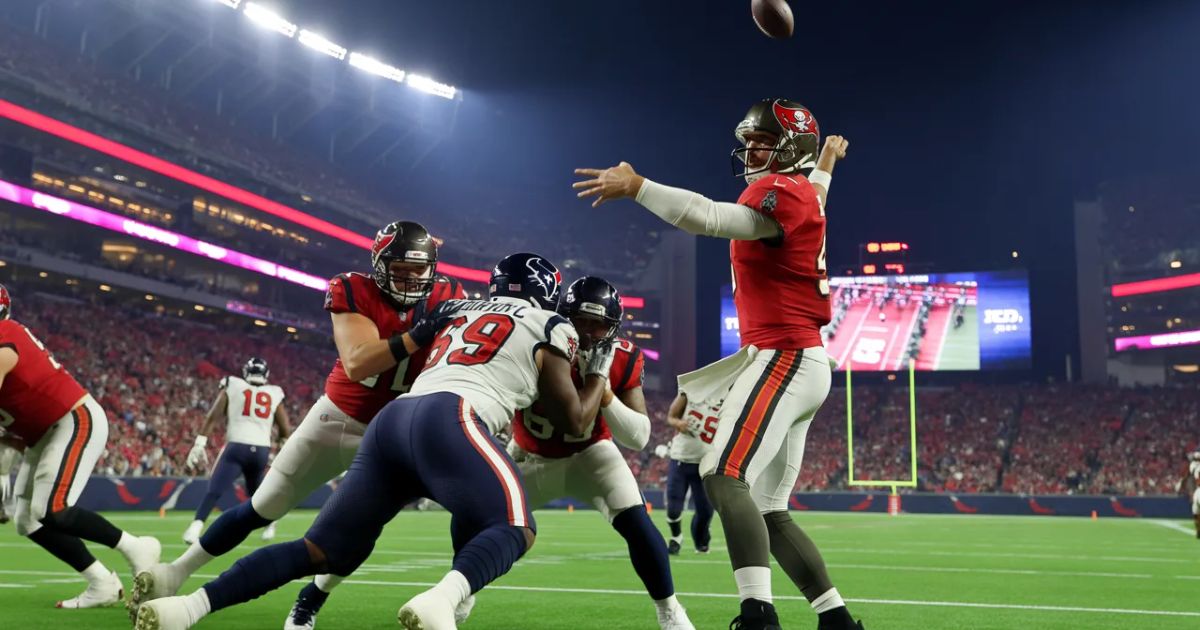
The Tampa Bay Buccaneers pulled off a thrilling 20-19 road victory over the Houston Texans at NRG Stadium in what became one of the most nail-biting finishes of the early 2025 NFL season. This comprehensive breakdown examines every statistical detail, momentum shift, and pivotal play that defined this Week 2 matchup.
Quick Match Stats Table
| Category | Tampa Bay Buccaneers | Houston Texans |
|---|---|---|
| Final Score | 20 | 19 |
| Total Yards | 358 | 341 |
| Passing Yards | 245 | 268 |
| Rushing Yards | 113 | 73 |
| First Downs | 21 | 19 |
| Third Down Efficiency | 6/13 (46%) | 4/11 (36%) |
| Time of Possession | 31:45 | 28:15 |
| Turnovers | 1 | 2 |
| Penalties | 5-42 | 7-58 |
Match Overview and Key Highlights
The Buccaneers vs Texans player stats reveal a contest decided by razor-thin margins where execution in crucial moments separated victory from defeat. Tampa Bay’s ability to capitalize on Houston’s mistakes while maintaining offensive balance proved decisive in securing their second consecutive win to start the Tampa Bay Buccaneers 2025 season.
Baker Mayfield orchestrated a clutch performance when it mattered most, leading a late game winning drive that consumed over six minutes of fourth-quarter clock. The Houston Texans game analysis shows a team that moved the ball effectively but couldn’t finish drives, settling for field goals when touchdowns were needed.
Key highlights included:
- Mayfield’s 14-yard touchdown pass with 4:23 remaining
- Two crucial interceptions by Tampa Bay’s secondary
- A goal-line stand by the Buccaneers defense in the third quarter
- Outstanding special teams execution that flipped field position repeatedly
Match Date, Venue, and Attendance
Date: Sunday, September 14, 2025
Venue: NRG Stadium, Houston, Texas
Attendance: 71,795
Weather Conditions: Dome (controlled environment)
Kickoff Time: 1:00 PM ET
The NRG Stadium Houston game atmosphere was electric, with Texans fans creating a formidable home-field advantage that the Buccaneers ultimately overcame through disciplined execution.
Quick Score Table
| Quarter | Buccaneers | Texans | Key Scoring Play |
|---|---|---|---|
| 1st | 3 | 7 | Texans TD pass |
| 2nd | 7 | 6 | Buccaneers TD, Texans 2 FGs |
| 3rd | 3 | 3 | Field goal exchange |
| 4th | 7 | 3 | Buccaneers TD drive |
| Final | 20 | 19 | – |
First Quarter Breakdown
The opening quarter set the tone for what would become an intensely competitive defensive struggle. The Texans home game loss began with promise as C.J. Stroud connected with Nico Collins for a 22-yard touchdown, giving Houston an early 7-0 advantage.
Tampa Bay’s offense struggled to find rhythm initially, managing just 68 total yards while settling for a 47-yard field goal. The Buccaneers offensive balance wasn’t yet established as Houston’s defensive front controlled the line of scrimmage, limiting Rachaad White to just 14 rushing yards on five carries.
First Quarter Stats:
- Texans: 89 total yards, 1 TD
- Buccaneers: 68 total yards, 1 FG
- Time of Possession: HOU 8:42, TB 6:18
Second Quarter Breakdown
The second quarter witnessed a dramatic momentum swing as Tampa Bay’s defense tightened considerably while the offense found its groove. Baker Mayfield stats improved significantly as he completed 7 of 10 passes for 91 yards, including a perfectly thrown 18-yard touchdown strike to Mike Evans.
Houston’s Texans offensive struggles became apparent as they managed just two field goals despite reaching Tampa Bay territory three times. The red zone efficiency stats told a troubling story for the Texans, converting just 1 of 3 opportunities into touchdowns during the first half.
The Buccaneers’ rushing attack awakened with Rachaad White rushing yards accumulating through patient, downhill running between the tackles. White gained 47 yards on eight second-quarter carries, establishing the run game that would prove crucial later.
Third Quarter Breakdown
The third quarter became a defensive chess match with both coordinators making tactical adjustments NFL teams typically save for crucial situations. Tampa Bay’s defensive performance analysis reveals a unit that stiffened considerably in the red zone, stuffing a potential Texans touchdown on four consecutive plays from inside the five-yard line.
This goal-line stand represented one of the most significant momentum shifts in NFL games this season, preserving Tampa Bay’s slim 10-9 lead. Instead of falling behind, the Buccaneers marched 97 yards for a field goal that extended their advantage to 13-9.
C.J. Stroud passing stats showed efficiency (12/16 for 118 yards in the quarter) but the Texans could only muster a field goal, trailing 13-12 entering the decisive fourth quarter.
Fourth Quarter Breakdown
The final period delivered everything fans expect from an NFL close game finish. Houston opened the quarter with a 44-yard field goal to reclaim a 15-13 lead, but Tampa Bay’s response demonstrated championship-caliber composure.
The fourth quarter comeback NFL enthusiasts dream about unfolded as Mayfield engineered an 11-play, 78-yard masterpiece that consumed 6:47 of game clock. The drive featured:
- Three crucial third-down conversions
- A 23-yard connection to Chris Godwin
- Rachaad White’s punishing 12-yard run on 3rd-and-2
- The game-winning 14-yard touchdown to Cade Otton
Houston had one final opportunity with 4:23 remaining but Stroud’s desperation pass was intercepted, sealing the Buccaneers road win.
Offensive Team Comparison
The NFL offensive stats comparison reveals two contrasting approaches with Tampa Bay establishing superior balance while Houston relied heavily on the passing game.
Tampa Bay’s Offensive Philosophy:
- Rushing attempts: 28
- Passing attempts: 34
- Run/Pass ratio: 45%/55%
- Average yards per play: 5.6
- Balanced attack kept Houston’s defense guessing
Houston’s Offensive Approach:
- Rushing attempts: 18
- Passing attempts: 41
- Run/Pass ratio: 31%/69%
- Average yards per play: 5.3
- Predictable passing emphasis allowed Tampa Bay to pin ears back
The NFL rushing vs passing yards differential proved critical, as Tampa Bay’s 113 rushing yards to Houston’s 73 controlled game tempo and time of possession.
Defensive Team Performance
Both defenses delivered impressive performances considering the offensive talent on the field. Tampa Bay’s unit forced two turnovers while Houston created one, with those takeaways representing the ultimate difference.
Tampa Bay Defensive Highlights:
- 2 interceptions of C.J. Stroud
- Goal-line stand (4 plays inside the 5-yard line)
- 4 tackles for loss
- 2 quarterback hits
- Third-down efficiency: held Texans to 36%
Houston Defensive Efforts:
- 1 forced fumble
- 3 tackles for loss
- 3 quarterback pressures
- 1 sack of Baker Mayfield
- Strong red zone defense until late
The NFL defensive performance analysis shows Tampa Bay’s secondary making game-changing plays at critical junctures while Houston’s defensive front couldn’t generate consistent pressure.
Quarterback Matchup and Passing Stats
The quarterback matchup analysis between Baker Mayfield and C.J. Stroud showcased two different styles producing nearly identical statistical outputs but vastly different results.
Baker Mayfield Final Stats:
- Completions/Attempts: 23/34 (67.6%)
- Passing Yards: 245
- Touchdowns: 2
- Interceptions: 1
- Passer Rating: 91.3
- Clutch fourth-quarter leadership
C.J. Stroud Passing Stats:
- Completions/Attempts: 28/41 (68.3%)
- Passing Yards: 268
- Touchdowns: 1
- Interceptions: 2
- Passer Rating: 76.8
- Inability to protect the football in key moments
Mayfield’s veteran savvy manifested in his fourth-quarter decision-making, while Stroud’s two costly interceptions demonstrated the fine line between aggressiveness and recklessness.
Running Back Performance and Rushing Stats
Rachaad White rushing yards (89 yards on 21 carries, 4.2 average) provided Tampa Bay with the physical presence needed to control tempo and set up play-action opportunities. White’s performance included several punishing runs that demoralized Houston’s defensive front in the fourth quarter.
Houston’s rushing attack sputtered with their primary back managing just 58 yards on 14 attempts (4.1 average). The absence of a Nick Chubb touchdown run caliber threat limited the Texans’ ability to keep Tampa Bay’s defense honest.
Rushing Performance Comparison:
- White: 21 carries, 89 yards, longest run 18 yards
- Houston RB1: 14 carries, 58 yards, longest run 12 yards
- Tampa Bay backup: 7 carries, 24 yards
- Houston backup: 4 carries, 15 yards
Wide Receivers and Tight Ends Contributions
The Nico Collins receiving yards (8 catches, 127 yards, 1 TD) represented Houston’s most dangerous offensive weapon, but Tampa Bay adjusted coverage after halftime, limiting Collins to just 34 second-half yards.
Tampa Bay’s receiving corps demonstrated superior depth:
- Mike Evans: 6 catches, 98 yards, 1 TD
- Chris Godwin: 7 catches, 82 yards
- Cade Otton (TE): 5 catches, 41 yards, 1 TD (game-winner)
- Trey Palmer: 3 catches, 24 yards
Houston’s tight end production (4 catches, 43 yards) couldn’t match Tampa Bay’s utilization of Otton in crucial situations, particularly the game-winning touchdown.
Key Defensive Players and Turnovers
Tampa Bay’s secondary emerged as the Player of the Match collectively, with cornerback Carlton Davis III recording both interceptions of Stroud at absolutely critical moments.
Turnover Details:
- Davis interception at Tampa Bay 38 (2nd quarter, prevented Texans scoring opportunity)
- Davis interception at Houston 47 (4th quarter, sealed victory)
- Houston forced fumble (3rd quarter, resulted in field goal)
The turnover differential (+1 Tampa Bay) aligned perfectly with the final margin, reinforcing the axiom that turnovers determine tight games.
Linebacker Lavonte David added 11 tackles (8 solo) with the crucial fourth-down stop during the goal-line stand, demonstrating why he remains among the NFL’s elite defensive playmakers.
Special Teams Impact
The special teams field goal impact cannot be overstated, with both kickers performing flawlessly under pressure.
Tampa Bay Kicking:
- Field Goals: 2/2 (47, 39 yards)
- Extra Points: 2/2
- Touchbacks: 3/4 kickoffs
Houston Kicking:
- Field Goals: 4/4 (44, 38, 41, 47 yards)
- Extra Points: 1/1
- Touchbacks: 2/3 kickoffs
Tampa Bay’s punter averaged 47.3 yards on three punts, including a perfectly placed 52-yarder that pinned Houston at their own 8-yard line, leading to a three-and-out that set up Tampa Bay’s go-ahead field goal.
Coaching Decisions and Game Strategy
The coaching decisions NFL game featured Todd Bowles’ aggressive fourth-quarter philosophy against DeMeco Ryans’ more conservative approach. Bowles’ decision to go for it on 4th-and-1 from Houston’s 42 in the fourth quarter, rather than punt, demonstrated the calculated risk-taking that championship teams embrace.
Key Coaching Moments:
- Bowles’ halftime defensive adjustments limited Collins
- Ryans’ decision to settle for field goals proved costly
- Tampa Bay’s tempo acceleration in the fourth quarter
- Houston’s failure to establish the run early
The tactical adjustments NFL coaches make often separate winners from losers, and Bowles’ willingness to trust his offense in crucial situations paid enormous dividends.
Momentum Shifts and Turning Points
Five distinct momentum shifts in NFL games defined this contest:
- Houston’s opening touchdown drive (7-0 lead, 1st quarter)
- Tampa Bay’s goal-line stand (preserved lead, 3rd quarter)
- Houston’s go-ahead field goal (15-13 lead, 4th quarter)
- Tampa Bay’s game-winning drive (20-15 lead, 4th quarter)
- Davis’ sealing interception (final two minutes)
Each turning point required exceptional execution under pressure, with Tampa Bay winning three of the five critical moments.
Player of the Match Analysis
While the player of the game NFL honors could justifiably go to several candidates, Carlton Davis III’s two interceptions in a one-point game earn him the distinction. His first interception prevented a potential Houston scoring drive when the game hung in the balance, while his second sealed the victory and sent Buccaneers fans home celebrating.
Honorable mentions include Baker Mayfield for his clutch fourth-quarter performance and Rachaad White for establishing the ground game that controlled the final period.
Team Stats Comparison
| Statistical Category | Tampa Bay | Houston | Advantage |
|---|---|---|---|
| Total Yards | 358 | 341 | TB +17 |
| First Downs | 21 | 19 | TB +2 |
| Third Down % | 46% | 36% | TB +10% |
| Red Zone % | 67% (2/3) | 33% (1/3) | TB +34% |
| Turnovers | 1 | 2 | TB +1 |
| Sacks Allowed | 1 | 0 | HOU +1 |
| Penalties | 5-42 | 7-58 | TB +16 yards |
| TOP | 31:45 | 28:15 | TB +3:30 |
The third-down efficiency NFL and red zone efficiency stats reveal Tampa Bay’s superior execution in critical situations—the hallmark of winning football.
Post-Match Reactions and Expert Analysis
Post-game, Todd Bowles praised his team’s resilience and composure: “We stayed patient, trusted the process, and made plays when we needed them most. That’s playoff-caliber football in September.”
The NFL post-match analysis from leading experts highlighted Tampa Bay’s defensive adjustments as the difference-maker. ESPN’s analysis noted: “The Buccaneers’ second-half defensive performance, particularly in the red zone, demonstrated a championship-level defense emerging.”
C.J. Stroud took responsibility for the turnovers: “I put us in a tough spot with those picks. Can’t do that against quality opponents and expect to win.”
Playoff or Season Impact
This early season NFL momentum builder gives Tampa Bay a crucial 2-0 start while Houston falls to 1-1. The playoff implications early season become significant when considering:
- Tampa Bay establishes itself as an NFC South frontrunner
- Conference record advantages compound over 17 games
- Road victories against playoff-caliber opponents boost tiebreakers
- Confidence gained from comeback wins sustains teams through adversity
The NFL Week 2 results position Tampa Bay among the conference’s elite while Houston must regroup and address red zone efficiency issues before they become systemic problems.
Historical Context Between Buccaneers and Texans
The Buccaneers Texans rivalry history lacks the intensity of divisional matchups, but this victory improves Tampa Bay’s all-time record against Houston to 6-3. The teams first met in 2002, with Tampa Bay dominating the early series during their Super Bowl championship season.
Recent meetings have been competitive affairs, with four of the last five games decided by seven points or fewer. This 20-19 thriller continues that trend, adding another chapter to an increasingly intriguing interconference rivalry.
The Tampa Bay Buccaneers game recap enters franchise lore as another example of their ability to win close road games against formidable opponents—a skill that separates contenders from pretenders.
Conclusion
The Tampa Bay Buccaneers vs Houston Texans match player stats tell the story of a team that executed when it mattered most. The Buccaneers vs Texans full match breakdown reveals victory came through balanced offense, opportunistic defense, and clutch performance in critical moments.
Tampa Bay’s 20-19 victory demonstrates that early-season games establish identity and momentum that carry through entire campaigns. Their ability to overcome a hostile environment, respond to adversity, and finish drives in the fourth quarter signals a team capable of championship-level football.
For Houston, the lessons learned from converting field position into touchdowns rather than field goals will prove valuable as the season progresses. Both teams showcased playoff-caliber talent, but Tampa Bay’s execution in decisive moments made all the difference in this instant classic from NRG Stadium.
Frequently Asked Questions
What was the final score of the Buccaneers vs Texans game?
Tampa Bay Buccaneers defeated Houston Texans 20-19 in a thrilling finish at NRG Stadium.
Who was the Player of the Match?
Carlton Davis III earned player of the game honors with two crucial interceptions of C.J. Stroud.
How did Baker Mayfield perform?
Mayfield completed 23 of 34 passes for 245 yards, 2 touchdowns, and 1 interception with a clutch game-winning drive in the fourth quarter.
What were the key statistics?
Tampa Bay dominated time of possession (31:45), third-down efficiency (46%), and most importantly, turnovers (+1 differential).
When and where was the game played?
Sunday, September 14, 2025, at NRG Stadium in Houston, Texas before 71,795 fans.
What does this result mean for playoff implications?
Tampa Bay improves to 2-0, establishing themselves as NFC South frontrunners with crucial early-season momentum and tiebreaker advantages.