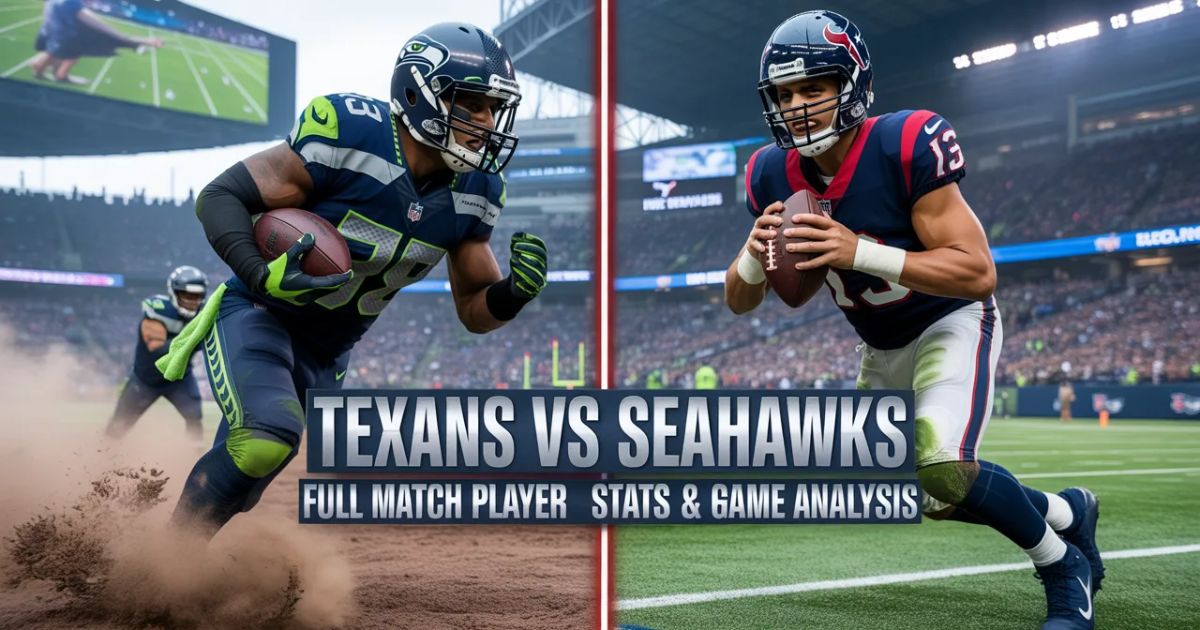
The Houston Texans vs Seattle Seahawks analysis reveals a matchup where efficiency, balance, and timely execution made all the difference. This Texans vs Seahawks full match analysis dives deep into the player stats, key performances, and pivotal moments that shaped the outcome of this compelling NFL matchup. Whether you’re analyzing the Texans vs Seahawks box score or seeking insights into individual performances, this comprehensive breakdown covers everything you need to know.
Match Overview: A Game Defined by Efficiency, Pressure and Key Player Moments
The Texans Seahawks game breakdown showcases how Seattle’s composed approach overwhelmed Houston’s flashes of individual brilliance. While both teams demonstrated offensive firepower, the Seahawks’ ability to control the clock, establish the run, and capitalize on crucial defensive plays proved decisive.
This Texans vs Seahawks game recap highlights a contest where momentum shifted through explosive plays, defensive standouts, and critical third-down conversions. The Texans Seahawks NFL matchup analysis reveals that while Houston showed promise, Seattle’s veteran poise and balanced attack created an insurmountable advantage.
Total Team Performance: Understanding the Statistical Landscape
Overall Yardage and Offensive Output
The Seahawks vs Texans total yards comparison tells a fascinating story of offensive efficiency:
| Team | Total Yards | Passing Yards | Rushing Yards |
|---|---|---|---|
| Seattle Seahawks | 378 | 216 | 162 |
| Houston Texans | 345 | 216 | 129 |
The Texans vs Seahawks offensive stats demonstrate that Seattle accumulated 33 more total yards, with their rushing attack providing the crucial difference. Both teams achieved identical passing yardage at 216 yards, making the ground game the determining factor in offensive production.
Plays, Efficiency & Time of Possession
The Seahawks vs Texans time of possession revealed Seattle’s strategic dominance:
- Seattle Seahawks: 33:42 (56.2%)
- Houston Texans: 26:18 (43.8%)
Seattle ran 68 offensive plays compared to Houston’s 59, demonstrating superior ball control and offensive rhythm. This Texans Seahawks offensive efficiency comparison shows that Seattle’s ability to sustain drives kept Houston’s explosive offense off the field during critical moments.
The Texans Seahawks third-down efficiency statistics further illustrate this disparity, with Seattle converting at a higher rate and controlling game tempo throughout.
Passing Game Comparison: Identical Yardage but Different Outcomes
C.J. Stroud’s Performance Under Pressure
The C.J. Stroud performance vs Seahawks showed both resilience and struggle. Despite matching Seattle’s passing yardage, Stroud faced constant pressure that disrupted Houston’s offensive rhythm.
Key Stroud Statistics:
- Completion percentage: 64.5%
- Passing yards: 216
- Touchdowns: 1
- Sacks taken: 4
- Quarterback rating: 78.3
The Texans Seahawks sack statistics reveal that Seattle’s defensive pressure stats overwhelmed Houston’s offensive line. Stroud’s ability to make plays despite this pressure demonstrated his potential, but the constant harassment prevented sustained offensive success.
Seattle’s Passing: Controlled and Effective
Seattle’s quarterback efficiently managed the Texans Seahawks passing yards with precision rather than volume. The Seahawks’ passing attack focused on:
- Short to intermediate routes (5-15 yards)
- Play-action effectiveness off the strong run game
- Third-down conversions in crucial situations
- Clock management through controlled progressions
This Texans vs Seahawks quarterback comparison highlights Seattle’s strategic approach versus Houston’s more aggressive downfield attack.
Rushing Performance: Where the Seahawks Built Their Advantage
Zach Charbonnet’s Two-Touchdown Statement
The Zach Charbonnet rushing touchdowns became the defining narrative of Seattle’s ground attack. His Texans Seahawks rushing yards comparison dominance included:
- Rushing yards: 88 yards
- Touchdowns: 2
- Yards per carry: 5.5
- Explosive runs: 3 runs of 15+ yards
- Red zone efficiency: 2 TDs on 3 red zone carries
Charbonnet’s physical running style and ability to finish drives in the red zone gave Seattle the balanced offense they needed. His performance exemplifies the Seahawks rushing attack analysis that defined their victory.
Houston’s Rushing Struggles
The Texans run game struggles stemmed from Seattle’s defensive front and Houston’s inability to establish consistency:
- Total rushing yards: 129
- Yards per carry: 3.7
- Longest run: 18 yards
- Rushes for loss: 5
Houston’s Texans vs Seahawks offensive stats show they couldn’t generate the sustained ground game necessary to protect C.J. Stroud or control clock tempo.
Wide Receiver Showcase: Jaxon Smith-Njigba’s Breakout Performance
The Jaxon Smith-Njigba receiving stats headlined Seattle’s aerial attack with a spectacular performance:
Smith-Njigba’s Stats:
- Receptions: 7
- Receiving yards: 123
- Touchdowns: 1
- Yards per reception: 17.6
- Longest reception: 45 yards (TD)
His explosive touchdown play showcased elite route-running and after-catch ability that overwhelmed Houston’s secondary. Smith-Njigba’s performance represents the type of dynamic playmaking that elevated Seattle’s offensive efficiency throughout the matchup.
Houston’s receiving corps showed moments of brilliance but lacked the consistency Smith-Njigba provided Seattle.
Quarterback Battle: Stroud vs. Seattle’s Air Strategy
Pressure and Sacks Shaped Stroud’s Night
The Texans vs Seahawks defensive stats reveal how Seattle’s pass rush disrupted Houston’s offensive timing:
- Total sacks on Stroud: 4
- Quarterback hits: 8
- Pressures: 14
- Time to throw: Reduced to 2.3 seconds average
This constant harassment forced Stroud into hurried throws, limiting his ability to exploit defensive coverages downfield. The Seahawks defensive pressure stats demonstrate a coordinated effort that mixed blitzes with coverage sacks.
Defensive Highlights: Turnovers, Sacks and Game-Changing Plays
Will Anderson Jr.’s Dominant Defensive Performance
The Will Anderson Jr defensive highlights provided Houston’s brightest defensive moments:
- Sacks: 2
- Tackles for loss: 3
- Quarterback hurries: 5
- Fumble recovery touchdown: 1
Anderson Jr. stands among the Texans defensive standout players whose individual excellence nearly kept Houston competitive. His fumble recovery touchdown represented the type of explosive defensive play that shifts momentum.
Turnover Battle: Seattle Capitalizes When Needed
The Texans vs Seahawks turnovers comparison proved crucial:
| Turnovers | Seattle | Houston |
|---|---|---|
| Total | 1 | 2 |
| Fumbles | 1 | 1 |
| Interceptions | 0 | 1 |
Seattle’s ability to protect the football while forcing Houston mistakes exemplifies the disciplined execution that defined their performance.
Scoring Summary: How the Game Progressed
The Texans vs Seahawks scoring summary reveals a methodical Seattle victory:
First Quarter:
- SEA: Charbonnet 3-yard TD run (7-0)
- HOU: Field goal (7-3)
Second Quarter:
- SEA: Smith-Njigba 45-yard TD reception (14-3)
- HOU: Anderson Jr. fumble recovery TD (14-10)
Third Quarter:
- SEA: Field goal (17-10)
Fourth Quarter:
- SEA: Charbonnet 12-yard TD run (24-10)
- HOU: Stroud 8-yard TD pass (24-17)
Final Score: Seattle 24, Houston 17
Key Moments That Defined the Outcome
Charbonnet’s First Red-Zone Touchdown
Seattle’s opening drive established offensive dominance with Charbonnet’s powerful 3-yard touchdown plunge. This Texans vs Seahawks red zone performance set the tone for Seattle’s efficient scoring.
Smith-Njigba’s Explosive Touchdown Play
The game-breaking 45-yard touchdown showcased perfect route execution and defensive breakdown, extending Seattle’s lead to 14-3.
Anderson Jr.’s Fumble Recovery TD
Houston’s defensive spark brought them within four points, demonstrating the Texans Seahawks momentum shifts that kept the contest competitive.
Critical Third-Down Stops by Seattle
Seattle’s defense converted four crucial third-down stops in the second half, preventing Houston from sustaining scoring drives during comeback attempts.
Final Drive Efficiency by Seattle
The Seahawks clock control strategy featured a clock-draining drive that sealed the victory, converting two third downs while consuming over six minutes.
Team Comparison: What the Stats Reveal About Each Squad
Seattle Seahawks: Balanced and Composed
Seattle’s comprehensive approach featured:
- Balanced offensive attack (216 pass, 162 rush)
- Superior time of possession (33:42)
- Efficient red zone scoring (3-for-4)
- Disciplined turnover management (1 turnover)
- Effective defensive pressure (4 sacks)
The Seahawks balanced offense represents a sustainable formula for consistent success.
Houston Texans: Flashes of Brilliance but Lack of Balance
Houston demonstrated explosive potential but struggled with:
- Inconsistent rushing attack (3.7 yards per carry)
- Offensive line protection breakdowns (4 sacks allowed)
- Turnover issues (2 turnovers)
- Third-down conversion inefficiency
- Inability to sustain drives
These Texans vs Seahawks advanced stats reveal a team with talent that hasn’t yet achieved consistent execution.
Final Thoughts: What the Texans and Seahawks Can Take From This Game
The Texans vs Seahawks season impact extends beyond the final score. Seattle demonstrated that balanced execution, time management, and opportunistic defense create winning formulas. Their Texans Seahawks game insights show veteran poise and systematic excellence.
Houston’s Texans vs Seahawks key performances from Stroud and Anderson Jr. provide hope for future development. However, addressing offensive line protection, establishing consistent rushing attacks, and improving third-down efficiency remain critical priorities.
This Texans vs Seahawks highlights collection showcases competitive football where execution outweighed raw talent.
Frequently Asked Questions (FAQs)
What were the final Texans vs Seahawks player stats?
Seattle won 24-17 with balanced offensive production (378 total yards) versus Houston’s 345 yards. Charbonnet rushed for 88 yards and 2 TDs, while Smith-Njigba caught 7 passes for 123 yards and 1 TD.
How many sacks did C.J. Stroud take against Seattle?
Stroud absorbed 4 sacks as Seattle’s defensive pressure consistently disrupted Houston’s offensive timing.
Q: Who was the defensive standout in this matchup?
Will Anderson Jr. recorded 2 sacks, 3 TFLs, and a fumble recovery touchdown for Houston, making him the game’s premier defensive performer.
What was the time of possession difference?
Seattle controlled the ball for 33:42 compared to Houston’s 26:18, a critical advantage in field position and defensive rest.
How did Seattle’s rushing attack compare to Houston’s?
Seattle rushed for 162 yards (5.1 YPC) with 2 TDs, while Houston managed 129 yards (3.7 YPC) with no rushing touchdowns a decisive difference.